Mobile App with Embedded AI
Design and Development
Fall 2026
Create mobile apps with embedded agent that can use tools and retrieve data to augment its reasoning. Code with AI as a team. Defend your choices in code reviews. Experience working in teams of 4-5 students. What features shall you include in your app? How good is your UI/UX design, really? We will adopt a data-driven approach to validate your design decisions. If you have never written a line of mobile code? Don’t worry, we will start from how to use a mobile IDE all the way to how to build reactive native mobile apps.
FA26 ADD DEADLINE Sep. 11th, 2026: in many CSE MDE/Capstone courses students form teams and begin accelerated work early in the semester. Attendance early in the term is critical for success. For the Fall 2026 term, the last day to enroll in these courses, including this one, is Sept. 11th, 2026.
Note: This course has combined lectures with the ULCS special-topic course EECS 498-008, Mobile Full-Stack with Streaming Data and Agentic AI. You can sign up for either, but not both.
If you have any questions about either course, please feel free to ask Prof. Sugih Jamin (sugih).
Students who have taken EECS 441 Sections 3 & 4 with Prof. Jamin cannot take either course for credit.
Room & Time
Lecture
1005 EECS
Discussion
3427 EECS
Tues. & Thurs.
10:30 – 12:00
Fri.
11:30 – 12:30
Staff & Office Hours
Sugih Jamin (sugih)
Tues. & Thurs. after lecture
And by appointment — 4737 BBB
Ryan Chen (chenryan)
Mon. & Tues. from 6:00 – 7:00
BBB Learning Center, Table 1
Gallery
A sample of projects from previous terms. Visit the full gallery for more.

Cookease — Available on Apple TestFlight
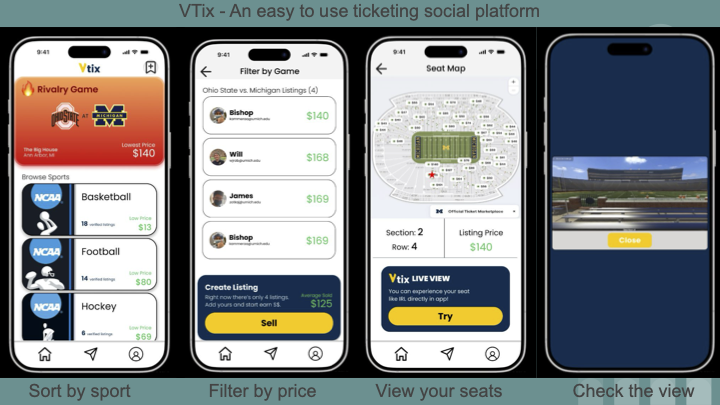
vTix — Available on Apple App Store

StatTrack
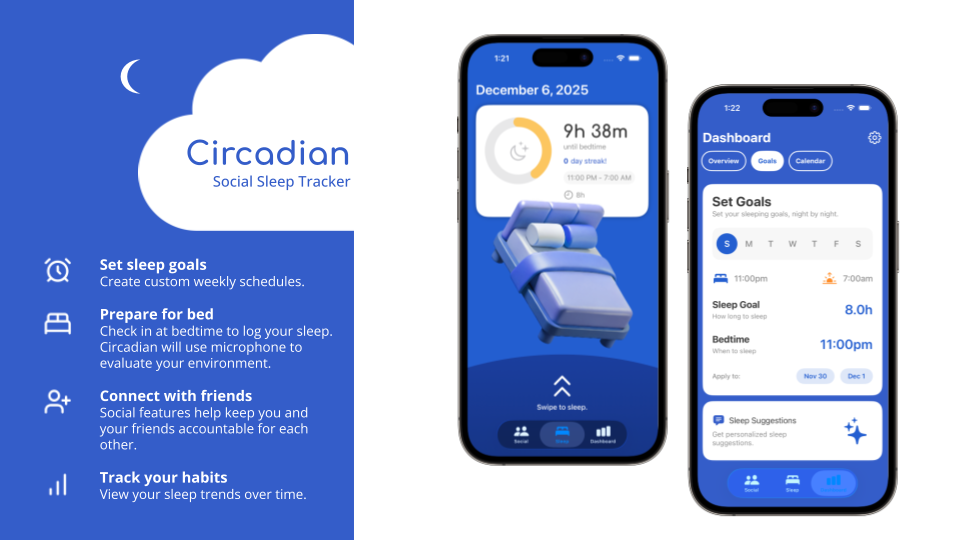
Circadian — Available on Apple TestFlight
Tutorials (for partial credit)
Preliminaries
- Getting started with Android development
- Getting started with iOS development
- Preparing GitHub for Tutorials and Projects
- Native-only development
llmPrompt
llmChat
llmTools
llmHITL
llmVec
llmRAG
MDE Project
Pitch
Proposal
Story Map
UIUX
Skeletal
MVP
Course Schedule
Loading schedule…
Grading Policy
Grading distribution
Rubric
A+ — Perfect
Perfect. Has that WOW factor.
A — Outstanding
Engineering work is outstanding. Creativity and novelty are clearly observable. The project goes beyond simply calling a third-party API and CRUD functionalities and presents the best possible accomplishments given the difficulty level and experience level of the student team. The amount of effort invested is substantial.
To qualify for an A-range grade, you must additionally satisfy one of the following:
- Make your team's project repo, agile management board, and presentation videos publicly available for posting on the course's gallery page; or
- Publicly beta test your project, either through Apple's TestFlight or Google's Testing Tracks and published it later on either Apple's App Store or Play Store.
B — Very Good
Engineering work is very good, though falls short in a few areas. Traces of creativity and novelty are observable. Project draws upon advanced coverage of ULCS coursework yet no noteworthy extension of knowledge is readily observable. The amount of effort invested is substantial but could be increased. Projects whose value proposition is met simply by calling a single third-party API, e.g., ChatGPT, Google speech recognition, or Amazon celebrity face recognition, would fall into this category and earn at most a B-range grade.
C — Minimally Acceptable
Engineering work is minimally acceptable. Projects core functionalities do not extend beyond simple CRUD (create, retrieve, update, delete) operations. Design fails to materialize through a refined process. Questionable design decisions are noted. Design rationale is not well-documented or simply not credible or not sound from a technical perspective. The project is below expectations with respect to a number of criteria; however it does score some successes which suggest project for the future. Students appear to be minimally prepared to undertake such endeavors unless significant refinement is implemented.
D — Questionable
Engineering work is questionable. Most deliverables are substandard. The project draws upon shallow and limited knowledge base. Given the difficulty level, accomplishments are minor although promising in certain aspects. There is potential that a fully functional prototype could be delivered if additional time is allotted.
E — Unclassifiable
Project could not possibly be classified into any of the above categories.
Policy on collaboration
You are required to work in a team of 4-5 members on course project. Tutorials may be completed either individually or in teams of at most 2 people. You may partner differently for each tutorial.
Acts of cheating and plagiarizing will be reported to the Engineering Honor Council. Cheating is copying, with or without modification, someone else's work not meant to be publicly accessible. Plagiarizing is copying publicly available work without acknowledging the original author. Review the College of Engineering Honor Code.
If you received substantial help from another person or AI/LLM, you must name and acknowledge them. Full citation required for any published materials used.
Regrade and late submission
You have one opportunity to fix bugs in each graded tutorial by the assigned office hour following its due date. Corrected code credited up to 50% of original points. Do not modify code on your git repo past the due date to remain eligible.
For all other work, you have two business days from when a grade is communicated to request a regrade in writing with technical justification. A regrade covers your whole submission and may result in a lower overall grade.
No late work will be accepted. All presentations must be submitted through Canvas by the deadline and, where requested, link to video posted on a Google spreadsheet. If you do not turn in an assignment by its due date, you will receive a zero for the assignment.
Extensions given only for documented medical and family emergencies. Cloud outages, encoding delays, laptop crashes, Bitlocker lockouts, and CAEN slowdowns do not qualify — plan for them. Keep an off-site backup (e.g., a remote git repo).
Letter grades and extra credit
Letter grades posted after the last day of final exams. There is no standard mapping from grade point ranges to letter grades.
Completing in-lecture code exercises, participation in peer evaluations, and providing feedback to other team's presentations earns extra credit that can top up your overall course grade. Missed opportunities for extra credit cannot be made up.
Tools
Course Infrastructure
Back-End Server